

 Türkçe
 Español
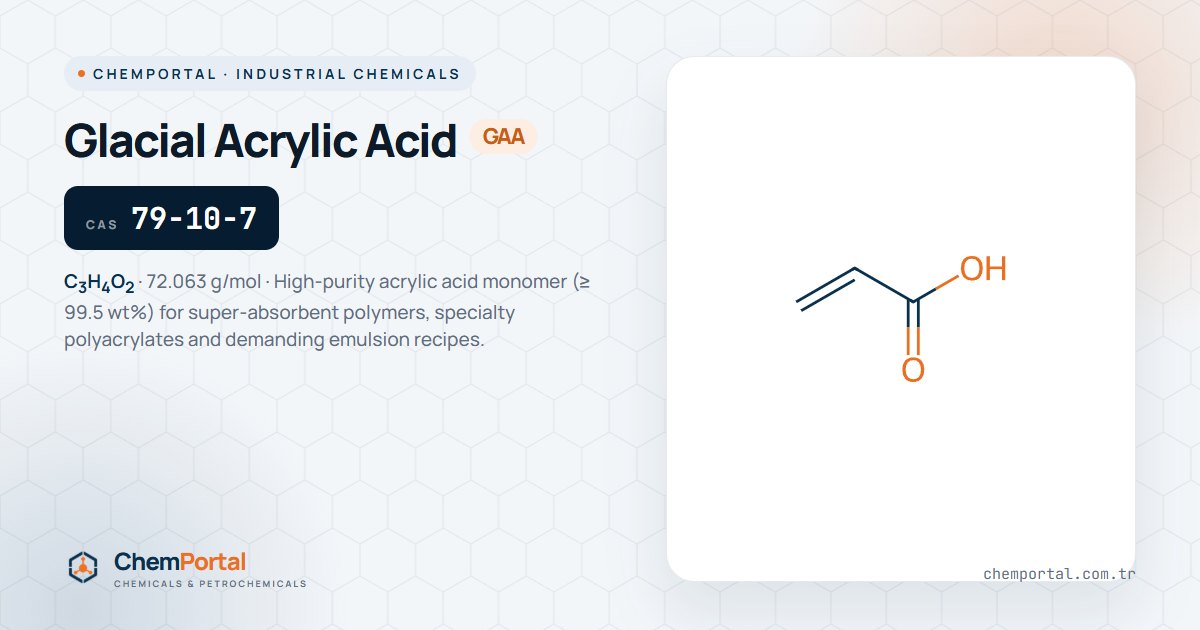
Product overview
Glacial acrylic acid (GAA) is the purified grade of acrylic acid, CAS 79-10-7, produced by distilling crude acrylic acid to remove water, acetic acid and other light impurities. The name refers to the way the pure product solidifies into ice-like crystals at 13 °C, exactly as glacial acetic acid does.
This grade is specified at a minimum purity of 99.5 wt%, with color ≤ 10 APHA, moisture ≤ 0.2 wt% and a density of 1.0461–1.0561 g/cm³ at 20 °C. It contains 200 ± 20 ppm MEHQ inhibitor and must be stored with air in the headspace so that the stabilizer can work.
The low level of impurities makes GAA the preferred feed for super-absorbent polymers, where chain transfer impurities would reduce absorbency, and for low-odor, low-VOC emulsion polymers. It boils at 140.9 °C, has a closed-cup flash point of 54 °C and ships as UN 2218, packing group II.
Key features
- Purity ≥ 99.5 wt%; low water and acetic-acid content
- Color ≤ 10 APHA, moisture ≤ 0.2 wt%
- 200 ± 20 ppm MEHQ inhibitor
- Crystallizes at 13 °C; boiling point 140.9 °C
- Supplied in plastic drums, IBC totes and ISO tank containers
Applications
- Super-absorbent polymers for diapers and hygiene products
- High-purity polyacrylic acid and sodium polyacrylate
- Emulsion polymers for coatings and pressure-sensitive adhesives
- Dispersants for detergents, ceramics and mineral slurries
- Flocculants and scale inhibitors in water treatment
- Specialty acrylate esters and cross-linkers
Analysis specification
| Parameter | Limit |
|---|---|
| Color (APHA) | ≤ 10 |
| Purity (wt%) | ≥ 99.5 |
| Density (at 20°C) g/cm³ | 1.0461-1.0561 |
| Moisture (wt%) | ≤ 0.2 |
| Polymerization inhibitor MEHQ (ppm) | 200±20 |
On a small screen, scroll the technical table horizontally.
Physical properties
- Appearance
- Colorless liquid
- Melting point
- 13 °C
- Boiling point
- 140.9 °C
- Flash point
- 54 °C (CC)
- Solubility
- Soluble
Identifiers
| CAS No. | 79-10-7 |
| EINECS No. | 201-177-9 |
| HS code | 2916110000 |
| Formula | C3H4O2 |
| Molecular weight | 72.063 g/mol |
| SMILES | C=CC(=O)O |
| InChI | InChI=1S/C3H4O2/c1-2-3(4)5/h2H,1H2,(H,4,5) |
| InChIKey | NIXOWILDQLNWCW-UHFFFAOYSA-N |
| Synonyms | GAA, glacial acrylic acid monomer, high-purity acrylic acid, prop-2-enoic acid 99.5% |
Transport & safety
- UN number
- UN 2218
- Packing group
- PG II
- Classification
- Corrosive articles
Dangerous-goods classification and handling instructions are provided in the safety data sheet, available on request.
Packaging & logistics
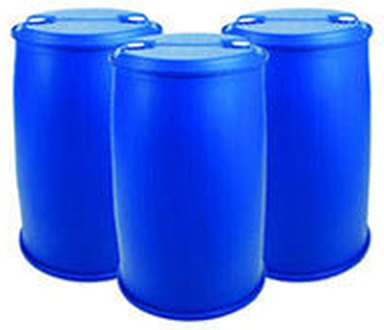
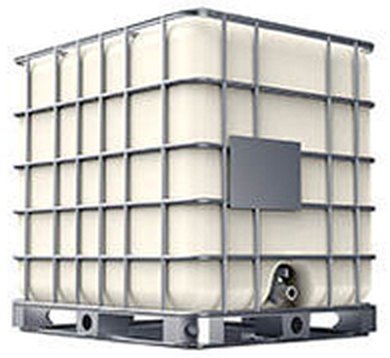
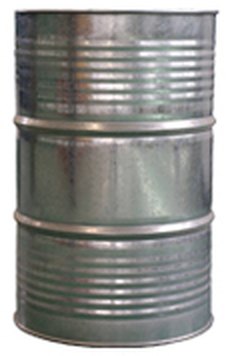
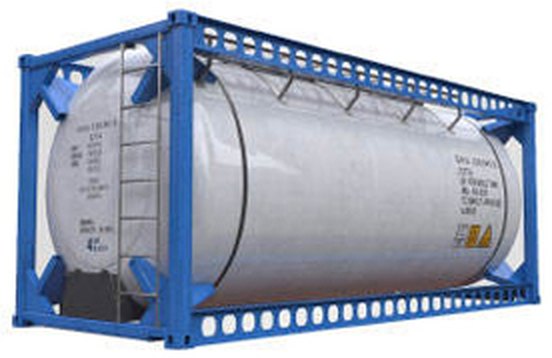
Standard packaging options. Confirm the packaging, lot size and delivery terms with your quotation.
Frequently asked questions
Why is it called glacial acrylic acid?
Because the high-purity product freezes into ice-like crystals at 13 °C. The term distinguishes the ≥ 99.5 wt% distilled grade from technical acrylic acid, in the same way that glacial acetic acid is distinguished from dilute acetic acid.
Can GAA replace technical acrylic acid in my process?
Usually yes, since both are the same molecule (CAS 79-10-7). GAA simply brings a tighter purity specification (≥ 99.5 wt% instead of ≥ 99.0 wt%), which matters most for SAP, high-molecular-weight polyacrylates and low-odor emulsions.
How is frozen GAA handled safely?
Thaw drums slowly in a warm room or with warm water below 35 °C, then mix thoroughly so the inhibitor is evenly distributed before use. Never apply steam, open flames or electric band heaters, and keep the headspace vented to air.
What documents come with a shipment?
Each lot is accompanied by a certificate of analysis; SDS and TDS are provided on request. Transport classification is UN 2218, packing group II.
Published reference specifications. Confirm the current grade, SDS / TDS / COA, packaging and delivery terms with your quotation.